01Schedules
47 years
of published Chicago schedules, carrier by carrier
- Departures & seats
- Routes & stage length
- 1980 to 2026
Answers
Who is building capacity?
The scoreboard
 DPAI
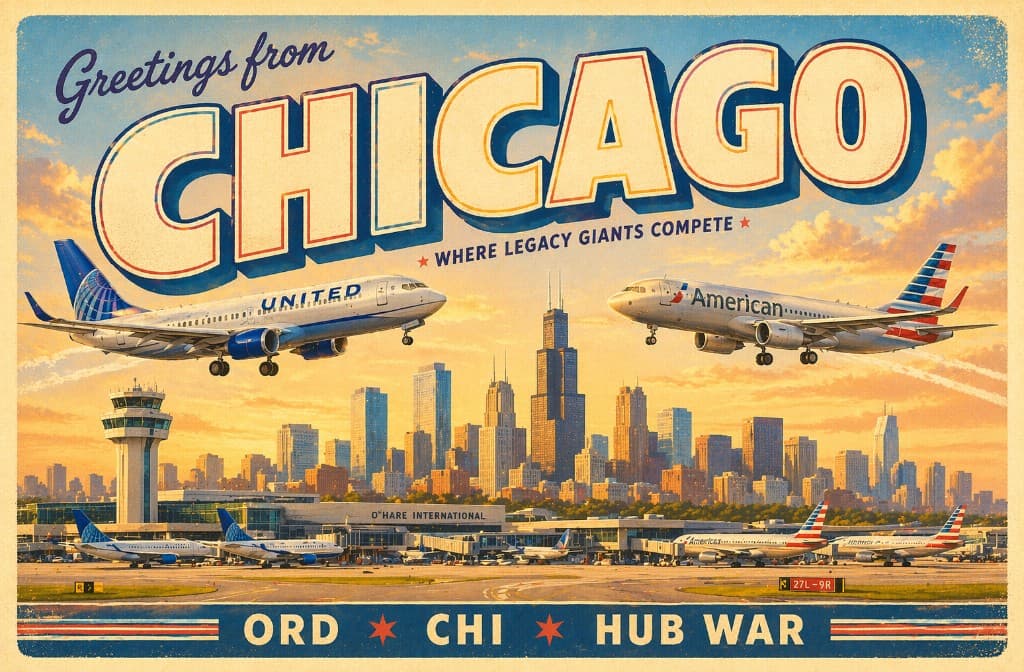
DPAIUnited vs. American at O'Hare: five decades of schedules, the routes where they fight flight for flight, and the travelers they are really competing for.
 DPAI
DPAIUnited vs. American at O'Hare: five decades of schedules, the routes where they fight flight for flight, and the travelers they are really competing for.
United and American have both run a hub at O'Hare for as long as these schedules go back. Schedules show who is winning the capacity race. Only traveler data shows whether they are fighting over the same people.
of published Chicago schedules, carrier by carrier
Who is building capacity?
O'Hare nonstop destinations on United or American in 2026
Where do they collide?
devices observed at O'Hare, Midway and Rockford
Are they chasing the same customer?
Who really owns O'Hare, and are United and American even competing for the same travelers?
 DPAIThe Chicago Hub Battle · Introduction
Through the early 1990s American ran almost as many Chicago departures as United. Then the lines separate, and they have never met again.
of United's departures
departures, and never matched since
departures, its largest Chicago schedule ever
From 1990 to 1996 American flew at least 94% of United's departures. It has not come that close since.
DPAIThe Chicago Hub Battle · 01 · Five Decades of SchedulesAmerican's Chicago schedule as a share of United's, year by year. At 100% the two hubs would be the same size.
of United's departures
of United's departures
of United's departures
In 2023 American fell to 69% of United's departures, the widest gap since 1987. It is back to 76%, but in seats it is still at 70%.
DPAIThe Chicago Hub Battle · 01 · Five Decades of SchedulesEvery O'Hare nonstop destination, each year, sorted three ways: served by both carriers, by United alone, or by American alone.
in 2026, up from 25 in 1980
destinations today; peak of 109 in 2014
destinations today, from 39 in 1999
Almost everywhere American flies from O'Hare, United flies too. The reverse is not true: United keeps 70 cities to itself.
DPAIThe Chicago Hub Battle · 01 · Five Decades of SchedulesSeats per departure tell the fleet story. Regional jets shrank both carriers through the 2000s; since COVID, United has upgauged faster.
United vs. American
United vs. American
United vs. American
United now puts about ten more seats on the average Chicago departure than American, and flies slightly longer stages.
DPAIThe Chicago Hub Battle · 01 · Five Decades of SchedulesForty-seven years of O'Hare schedules, drawn route by route. Line weight is scheduled departures. Press play to watch the two networks grow into each other.
destinations · – departures
destinations · – departures
destinations served by both carriers
In 1980 the two carriers shared 25 destinations. Today they share 164.
DPAIThe Chicago Hub Battle · 02 · The BattlegroundThe busiest O'Hare destinations that both carriers serve, by scheduled departures in the year.
of 256 O'Hare destinations on either carrier
of departures on shared routes
of departures on shared routes
Nearly all of American's O'Hare schedule runs straight into United. In 2026, LaGuardia and Washington National are the biggest battlegrounds.
DPAIThe Chicago Hub Battle · 02 · The BattlegroundO'Hare departures to each airline's other hubs, as they stand since the 2010 and 2013 mergers. Connecting traffic makes these the routes neither will give up.
routes where the airline that owns the far end flies more
of departures are United's
of departures are American's
O'Hare is a spoke as well as a hub. Each airline feeds its own network first, and Washington Dulles is United's alone.
DPAIThe Chicago Hub Battle · 02 · The BattlegroundChicago's second airport has had three hub carriers. Midway Airlines and ATA are gone. Southwest is the only one left, and it has outgrown both.
Chicago departures on 95 routes, about a third of United's
last year flown
last year flown
United and American barely touch Midway. The O'Hare fight is between two network carriers; Southwest competes for Chicago from the side.
DPAIThe Chicago Hub Battle · 02 · The BattlegroundDevices seen at United's and American's O'Hare gates, profiled by the census make-up of the neighborhoods they come home to.
across 22 age, income, education and race groups
of travelers' home areas
of travelers' home areas
Switch between dimensions: the bars barely move. At O'Hare, United and American are fighting over the same customer, so the battle is won on schedule, not audience.
DPAIThe Chicago Hub Battle · 03 · Who FliesPut Midway and Rockford next to the two O'Hare carriers and the differences finally show up. Airport choice sorts Chicago travelers more than airline choice does.
Average difference across 22 age, income, education and race groups.
Rockford is the outlier: older, fewer degrees and homes worth about 30% less. Midway matches O'Hare on income but has a larger Hispanic and Black share.
DPAIThe Chicago Hub Battle · 03 · Who Flies